

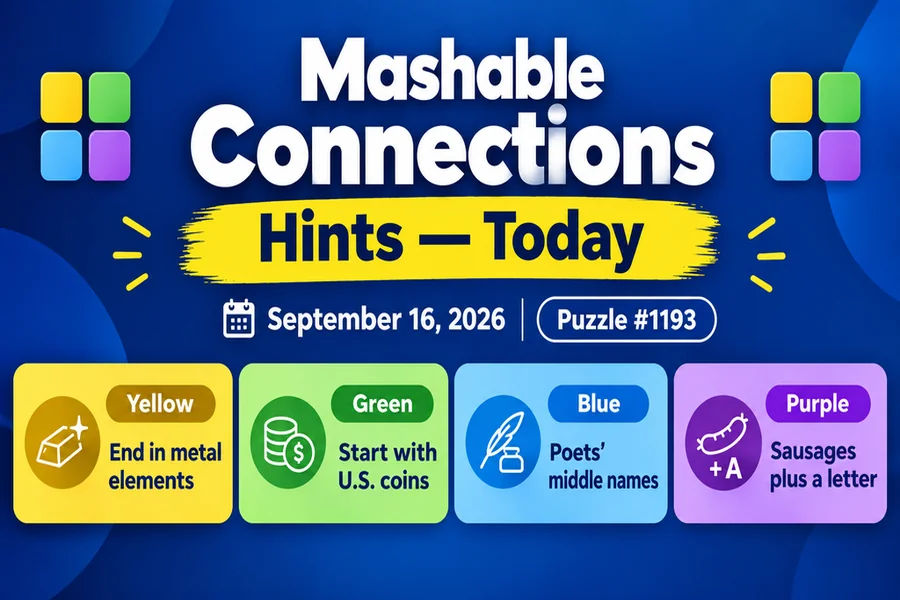
What Is Mashable Connections Hint Today?
If you searched for mashable connections hint today you are probably trying to solve the latest NYT Connections puzzle without immediately seeing the full answer. Mashable regularly publishes daily puzzle guides that include clues and answers for Connections. Its current coverage also includes separate articles focused on word meanings and another focused on clues and answers.
This type of daily guide can be useful when you are stuck on one category but still want to finish the puzzle yourself. Instead of looking directly at all four groups you can use a clue to push your thinking in the right direction.
That distinction matters because Connections is designed around finding relationships between words. Seeing every answer immediately can remove much of the challenge. A well-timed hint can give you enough information to continue while still leaving part of the puzzle for you to solve.
For September 19, 2026 the current puzzle is Connections #1196. The puzzle contains 16 entries that must be divided into four groups of four. Current puzzle coverage identifies themes involving broadening one’s scope, children’s drawings, 1960s London culture and abbreviated mathematical functions.
The best way to use a Mashable-style Connections hint is therefore not simply to search for the answer. Start with the smallest amount of help you need and only move toward the full solution when you are genuinely stuck.
What Is NYT Connections?
Connections is a word puzzle from The New York Times. The basic objective is simple. Players receive a grid containing 16 words or phrases and must organize them into four groups of four.
Each group has a hidden relationship.
The relationship might involve meanings. It could involve people. It might relate to movies. It can involve geography. Sometimes the connection depends on spelling or wordplay.
The challenge comes from the fact that several words can appear to belong together even when they do not.
For example a word such as “house” might connect with several different concepts. It could relate to buildings. It could relate to television. It could appear in a phrase. It might even be part of a completely unexpected wordplay category.
That is why Connections requires more than simply identifying four words that have something in common.
The game gives players four mistakes before the puzzle ends. Players can also shuffle the board when the arrangement of the words makes patterns difficult to see. Current descriptions of the game also note the familiar color order of yellow, green, blue and purple.
How the Connections Grid Works
Every daily Connections puzzle begins with 16 entries.
Your goal is to find four groups.
Each group contains exactly four entries.
Once you correctly identify a group the four words are removed from the board. This leaves fewer words to analyze and can make the remaining categories easier to see.
The important part is that the connection must be intentional.
Four words can have a loose relationship without forming a correct group. The puzzle is designed to create these false connections. That is one reason why guessing too quickly can waste your limited attempts.
A useful solving method is to ask:
- What do these words have in common?
- Could more than four words fit this idea?
- Is there a more precise relationship?
- Could one of these words belong to another category?
- Does the category explain all four words equally well?
These questions can prevent many unnecessary mistakes.
If you are still stuck after looking at the board from several angles then a mashable connections hint today search can provide another way to approach the puzzle.
Understanding the Four Connection Colors
The four Connections groups are commonly shown using four colors.
| Color | General difficulty | Typical solving approach |
| Yellow | Easiest | Look for direct meanings or obvious relationships |
| Green | Moderate | Consider familiar associations and phrases |
| Blue | Harder | Think about specialized knowledge or indirect links |
| Purple | Hardest | Look for wordplay and less obvious relationships |
The colors represent increasing difficulty rather than four fixed types of categories.
That distinction is important.
Yellow does not always mean synonyms. Purple does not always mean a particular kind of wordplay. The category can vary from one puzzle to another.
The colors are mainly a guide to how direct or indirect the intended relationship may be.
For beginners this gives you a useful strategy. If you see a group that appears extremely obvious then it may be worth testing first. Removing that group can make the remaining words much easier to understand.
However you should still be careful. An obvious-looking group can sometimes be a trap.
Mashable Connections Hints Today and Spoiler Levels
One of the biggest advantages of a good daily Connections guide is that it can provide different levels of assistance.
A reader may only need a broad clue.
Another player may need the actual category.
Someone else may need the four answers.
These are very different levels of spoilers.
A useful spoiler progression looks like this:
Level 1: General clue
This gives you a direction without revealing the exact category.
Level 2: Category clue
This tells you what the four words have in common but does not necessarily list the answers.
Level 3: Individual word help
This can confirm whether a particular word belongs to a group.
Level 4: Full solution
This reveals the category and all four words.
This approach lets players decide how much help they want.
When searching for mashable connections hint today, readers should pay attention to where the answer section begins. Daily puzzle articles often place hints before the complete solution so players can stop reading once they have enough information.
Today’s Mashable Connections Hint for September 19
For September 19, 2026 the daily puzzle is Connections #1196. Current coverage lists 16 entries and four themes.
If you want to solve today’s puzzle yourself then stop here after reading the broad clues below.
Yellow clue
Think about making your range or possibilities broader.
Green clue
Think about things commonly found in a simple drawing made by a child.
Blue clue
Think about fashion and cultural life associated with London during the 1960s.
Purple clue
Look at the beginning of the phrases and think about abbreviated mathematical functions.
These clues are intentionally less direct than the final categories. They are meant to give your brain a direction without immediately completing the puzzle.
If you can solve the four groups from these clues then you have probably received enough help.
Today’s Full Connections Answers
Spoiler warning: The information below reveals the solution for September 19, 2026.
The four groups reported for Connections #1196 are:
| Color | Category | Words |
| Yellow | Widen one’s scope | Branch Out, Diversify, Expand, Grow |
| Green | Features of a kid’s drawing | House, Stick Figure, Sun, Tree |
| Blue | Associated with Swinging London in the 1960s | Carnaby Street, Miniskirt, Mod, Twiggy |
| Purple | Starting with abbreviated math functions | Cos Lettuce, Log Cabin, Sin City, Tan Line |
These groupings are independently reported in current puzzle coverage.
The purple group is particularly useful for understanding how Connections can disguise a relationship.
At first glance Cos Lettuce, Log Cabin, Sin City and Tan Line appear unrelated.
The trick is to examine their beginnings.
“Cos” can represent cosine.
“Log” represents logarithm.
“Sin” represents sine.
“Tan” represents tangent.
The connection is therefore not based on the ordinary meanings of the complete phrases. It is based on the abbreviated mathematical functions at the beginning.
This is exactly the type of unexpected relationship that can make Connections difficult.
Why Today’s Purple Category Is Tricky
Purple categories often require you to stop thinking about the obvious meaning of a word.
Consider Cos Lettuce.
If you focus on “lettuce” your brain may immediately move toward vegetables or food.
But the puzzle is asking you to look at the beginning of the phrase.
The same idea applies to Log Cabin.
A cabin is a building. Yet the important part for today’s category is “log.”
The same pattern appears with Sin City and Tan Line.
This is an important general Connections lesson.
When a word does not seem to fit anywhere ask whether only part of the entry matters.
The relevant feature might be:
- The first word
- The last word
- A prefix
- A suffix
- A sound
- A spelling pattern
- A hidden word
- An abbreviation
- A double meaning
That mindset can help with future puzzles even when today’s exact category is forgotten.
How to Use Mashable Hints Without Ruining the Puzzle
The easiest way to spoil a Connections puzzle is to search for the answer before deciding how much help you actually need.
A better approach is to use hints in stages.
First solve the puzzle on your own.
Give yourself enough time to scan all 16 entries.
Next identify any obvious relationships.
If you find a possible group then test whether exactly four words fit.
If you are still uncertain search for a spoiler-free clue.
Read only the first hint.
Return to the puzzle.
If the clue does not help then move to the next level.
This process allows you to keep solving instead of turning the puzzle into an answer-reading exercise.
For example today’s purple category is difficult if you only look at the ordinary meanings of the words. Once you know that the group involves abbreviated mathematical functions the four phrases become much easier to identify.
The hint supplies the direction.
Your brain still has to make the final connection.
How to Solve Connections Before Looking for Hints
You can improve your chances of solving the daily puzzle without outside help by following a repeatable process.
Start by reading all 16 entries.
Do not immediately select four.
Instead look for repeated ideas.
Maybe several entries are foods. Maybe several are names. Maybe several can follow the same word.
Next look for an unusually strong connection.
If four entries clearly share a relationship test them.
Do not submit the group simply because four words seem related.
Ask whether a fifth word also fits.
If five words fit your theory then your category may be too broad.
This is one of the most important Connections habits.
The intended category must usually be more specific than your first idea.
Once you have a confirmed group remove it mentally from the board and reassess everything else.
A new pattern often becomes visible after four words disappear.
Watch Out for Red Herrings
Connections is deliberately built around misleading possibilities.
A red herring is a word or relationship that appears useful but ultimately points you in the wrong direction.
Suppose three words clearly relate to music.
You may immediately search for a fourth music-related word.
But perhaps one of those three belongs to another category.
That is why Connections can feel frustrating even when you understand every word.
The difficulty is often not vocabulary.
It is choosing the intended relationship.
Today’s puzzle provides several examples of why context matters.
Words such as House and Tree can appear together because both can represent ordinary objects or things seen in drawings. Meanwhile Miniskirt and Twiggy can immediately suggest fashion.
Those observations are useful but they do not necessarily complete the entire puzzle.
Current puzzle coverage specifically highlights the possibility of misleading associations in today’s grid.
What Does One Away Mean?
Another useful feature in Connections is the “One Away” message.
When you submit four words and the game indicates that you are one away it means that three of your selected words belong together while one does not.
This is valuable information.
Instead of completely abandoning your idea you can reconsider each word.
Ask which one is the weakest member.
Then look at the remaining words for a replacement.
This can turn a failed attempt into a successful category.
However you should still avoid repeatedly guessing.
You only have a limited number of mistakes.
Use the feedback as evidence rather than simply clicking through combinations.
Why Connections Can Feel Difficult
Connections is not difficult only because of vocabulary.
Several other factors can make a puzzle challenging.
Multiple meanings
A word may have several meanings.
That means it can appear relevant to more than one category.
Cultural knowledge
Some groups depend on movies, music, history, geography or popular culture.
A player unfamiliar with the reference may struggle even if the words themselves are easy.
Wordplay
Some categories depend on prefixes, suffixes, abbreviations or sounds.
The complete phrase may be irrelevant.
Overlapping relationships
Several words may appear to fit one broad idea.
The actual category may be narrower.
Unusual phrases
The puzzle may use names or phrases that are not common in everyday conversation.
These elements combine to create the challenge.
That is also why a carefully written hint can be more useful than a simple answer list.
Common Types of Connections Categories
Although every puzzle can be different there are recurring category styles.
Some groups involve synonyms.
Others involve words that can follow the same word.
Some use names of people.
Others use places or products.
You may also encounter:
- Movie titles
- Television references
- Food
- Sports
- Geography
- Music
- Books
- Animals
- Abbreviations
- Homophones
- Prefixes
- Suffixes
- Rhyming words
- Hidden words
- Double meanings
- Word fragments
Learning to recognize these patterns can make future puzzles easier.
It also changes the way you read a daily hint.
Instead of asking only “What are the answers?” you can ask “What kind of connection is the puzzle asking me to notice?”
That is a much more useful question.
How Mashable Hints Can Help Beginners
Beginners often make one common mistake.
They treat every connection as a direct definition.
For example if four words seem to be types of objects they may assume that is the category.
Connections often requires a second level of thinking.
A hint can teach beginners to look beyond the basic definition.
Suppose a clue says the group is related to “abbreviated math functions.”
Now the player knows that the connection may involve the beginning of each phrase.
That gives them a method they can reuse.
The same thing applies to a clue about a historical period.
Instead of searching only for words with the same meaning the player can look for names, places, fashion or cultural references associated with that period.
Over time this can make the solving process more systematic.
Mashable Connections Hints for Non-Native English Speakers
Connections can be especially challenging for people who use English as a second language.
A word may be familiar while a phrase containing that word is not.
Idioms can also create problems.
Cultural references can be even harder.
For example a player may know what a “miniskirt” is but may not immediately connect it with the cultural idea of Swinging London in the 1960s.
Similarly a player may recognize “sin” as a normal English word without realizing that it can function as an abbreviated mathematical term in a wordplay category.
This is where hints can provide valuable context.
A good hint gives you information about the type of relationship rather than simply giving you the answer.
That makes the puzzle more accessible while preserving some of the challenge.
Is Using a Connections Hint Cheating?
There is no single rule that determines whether using a hint is cheating.
It depends on how you personally want to play.
Some players prefer solving every puzzle without assistance.
Others use hints when they become stuck.
Some players only check the answer after completing several attempts.
Others enjoy learning how the category was constructed.
None of these approaches changes the underlying puzzle.
If your goal is to test yourself then you may want to avoid hints until you are completely stuck.
If your goal is to enjoy the puzzle and learn new connections then a small clue can be part of the experience.
The important distinction is between getting assistance and having the entire puzzle solved for you.
A category hint still leaves the actual grouping task to the player.
Mashable Hints vs Full Answers
A hint and an answer serve different purposes.
A hint points toward the solution.
An answer reveals it.
| Help type | What it gives you | Spoiler level |
| General clue | Broad direction | Low |
| Category clue | The main relationship | Medium |
| Word clue | Help with a specific entry | Medium |
| Category plus words | Complete group | High |
| Full answers | Entire puzzle solution | Highest |
If you want to preserve the challenge then category clues are usually the logical middle ground.
They tell you what to look for without necessarily telling you exactly which words to select.
That is especially useful for difficult purple groups.
A Better Daily Routine for Connections
You can build a simple daily routine around the puzzle.
Start by solving without assistance.
Spend several minutes scanning the entire board.
Write down possible relationships mentally or on paper.
Find your strongest candidate.
Check whether exactly four words fit.
Submit only when you are reasonably confident.
If you get stuck use one hint.
Return to the puzzle.
If you still cannot solve it use a stronger clue.
This method prevents you from jumping directly from “I am stuck” to “show me everything.”
It also gives you an opportunity to learn from each puzzle.
After finishing ask yourself what trick caused the most difficulty.
Was it a double meaning?
A cultural reference?
A phrase?
A word fragment?
A misleading category?
That reflection can improve your approach to the next day’s puzzle.
How to Use Today’s Puzzle as a Learning Example
Today’s September 19 puzzle is useful because its four categories demonstrate four different styles of thinking.
The yellow group is meaning-based.
The words point toward increasing range or scope.
The green group is based on familiar visual subjects associated with children’s drawings.
The blue group requires cultural knowledge connected to 1960s London.
The purple group relies on wordplay involving mathematical abbreviations.
That progression shows why Connections can feel unpredictable.
A player who is excellent at vocabulary may solve yellow quickly but struggle with blue.
Someone who knows mathematics may spot purple immediately.
Another player may recognize the 1960s cultural references and solve blue before everything else.
There is no single skill that guarantees a quick solve.
What to Do After Making a Mistake
A wrong guess does not necessarily mean your entire idea was bad.
If you receive “One Away” then inspect the four words again.
If you receive no such indication then reconsider the category itself.
Do not keep submitting nearly identical combinations.
Instead remove the weakest assumption.
Shuffle the board if the arrangement is distracting you.
Look for a completely different relationship.
This change of perspective can be surprisingly effective.
If you are still stuck then use a Mashable hint.
The goal is not to avoid every mistake.
The goal is to use each mistake as information.
Why Word Order Can Mislead You
The original placement of the words does not necessarily tell you anything about their categories.
A group may appear scattered across the board.
That is intentional.
Shuffling can help because it removes the visual attachment you may have developed to the original arrangement.
If you keep seeing the same four words together simply because they are positioned close to each other then a shuffle can reset your attention.
Try reading the words in different directions.
Look at each row.
Then each column.
Then ignore the grid completely and consider the words as one list.
Changing the visual structure can reveal relationships that were difficult to see before.
How to Avoid Overthinking Easy Groups
There is also an opposite problem.
Sometimes players overthink an obvious category because they expect a trick.
If four words have an unusually strong and precise relationship then test it.
Do not reject an answer simply because it feels too easy.
Connections contains different difficulty levels for a reason.
Yellow categories can be relatively direct.
The challenge often becomes greater as you move toward blue and purple.
A good solving strategy therefore combines confidence with caution.
Take obvious relationships seriously but verify them before submitting.
How to Build a Personal Connections Strategy
After playing several puzzles you may notice that you have certain strengths.
Maybe you are good with movies.
Maybe you recognize geography quickly.
Maybe wordplay is your strength.
Maybe cultural references are difficult.
Use that knowledge.
If you are strong at direct vocabulary categories then look for those first.
If you struggle with wordplay then leave unusual entries aside and return to them later.
Do not force yourself to solve the puzzle in a fixed order.
Connections rewards flexibility.
The most useful strategy is the one that helps you identify reliable groups while preserving your limited attempts.
What Makes a Good Daily Hint?
A useful daily hint should provide enough information to move the player forward without necessarily eliminating all of the challenge.
A poor hint can be too vague.
Another can reveal so much that the puzzle becomes meaningless.
The best middle ground depends on the player.
For a beginner a broad clue may still be difficult.
For an experienced player the same clue may immediately reveal the entire category.
That is why having multiple levels of assistance is useful.
Current Mashable coverage demonstrates that its daily Connections material can include both clue-focused coverage and separate word-meaning coverage.
This also explains why people searching for mashable connections hint today may be looking for different things. One reader may want category clues. Another may want word meanings. Someone else may want the final answers.
Mashable Connections Hint Today: Quick Reference
If you are searching specifically for today’s puzzle then here is a spoiler-controlled summary for September 19, 2026.
Puzzle: Connections #1196
Yellow: Think about widening your range or scope.
Green: Think about common subjects in a child’s drawing.
Blue: Think about 1960s London fashion and culture.
Purple: Look for phrases beginning with abbreviated mathematical functions.
The full groups are listed earlier in this article for readers who want to check their solution. Current sources confirm these categories and word groupings.
If you have not solved the puzzle yet then the four clues above may be all the information you need.
Frequently Asked Questions About Mashable Connections Hint Today
What is the Mashable Connections hint today?
It refers to the daily Connections clues published by Mashable to help players solve the current NYT Connections puzzle. Mashable also publishes complete answers.
What is today’s Connections puzzle number?
The September 19, 2026 puzzle is Connections #1196.
How many words are in Connections?
Each puzzle contains 16 words or phrases that must be separated into four groups of four.
What do the Connections colors mean?
Yellow is generally the easiest group followed by green, blue and purple. The colors indicate relative difficulty.
How many mistakes can you make?
Players get four mistakes before the puzzle ends.
What does One Away mean?
It means three of your four selected words belong to the same group while one word is incorrect.
Can Mashable hints spoil the puzzle?
They can if you continue into the full-answer section. Stop after the category clues if you want to preserve the challenge.
Why is purple often difficult?
Purple groups frequently use less obvious relationships or wordplay. However the exact type of category changes every day.
Can beginners use Connections hints?
Yes. A broad hint can help beginners understand the type of relationship without revealing the complete answer.
Does Connections reset every day?
Yes. A new daily puzzle replaces the previous one.
Final Thought
The mashable connections hint today search is useful for players who want help without immediately giving up on the puzzle. The best approach is to use hints gradually.
Start with the 16 words. Look for precise relationships. Check for red herrings and overlapping meanings. Use a broad clue when you are stuck and reveal the full answers only when you are ready.
Today’s September 19 puzzle shows why this method works. Its groups range from straightforward meanings to children’s drawings, 1960s London culture and mathematical wordplay.
A good hint does not have to solve the puzzle for you. Sometimes it only needs to point your thinking in the right direction.
